
When you launch your product, do you think it will be successful and reach the right audience?
You’ve spent months creating something you firmly believe in. On paper, everything looks perfect. However, when the product goes live, the response falls short of expectations. Not because your product lacks value, but because the path to your customers was not clear.
That’s where a go-to-market strategy framework comes into force. It’s not just a product launch, it’s a debut with clarity, direction, and purpose.
In this blog, you’ll learn how GTM strategy frameworks work, why they matter, and how proven models can help you attract the right audience and scale effectively.
What is a Go-To-Market (GTM) Strategy?
A go-to-market (GTM) strategy is your plan for bringing a product to market and effectively reaching your target audience. It sets your product positioning, your value communication, and your customer delivery.
An effective GTM strategy allows you to align your product, marketing, and sales efforts so that everything works together with simplicity and direction. It allows you to find the right users, with the right message, at the right time.
If you’re launching a new product or entering a new market, a defined GTM strategy framework will increase your chances of success.
Key Elements of a Successful GTM Strategy
A successful go-to-market strategy is based on a few key components that ensure simplicity, alignment, and impact. These elements allow you to effectively connect your product with the ideal audience.
- Target audience & segmentation: Segment by needs, behaviors, and demographics to find your ideal customers. This will ensure that your GTM strategy is targeting the right audience.
- Value proposition: Explain the benefits of your product that are different from others and how it solves a certain problem. This will make it easier for customers to understand why they should choose you.
- Pricing & positioning: Create a pricing strategy that reflects your product’s value and positions it competitively in the market to attract and retain your target audience.
- Distribution channels: Choose the best channels, such as digital platforms, partnerships, or direct sales, to successfully reach customers where they are most active.
- Messaging & sales alignment: Make sure your marketing and sales teams are communicating clearly and consistently to develop trust with your customers.
6 Top GTM Strategy Frameworks Used by Successful Companies
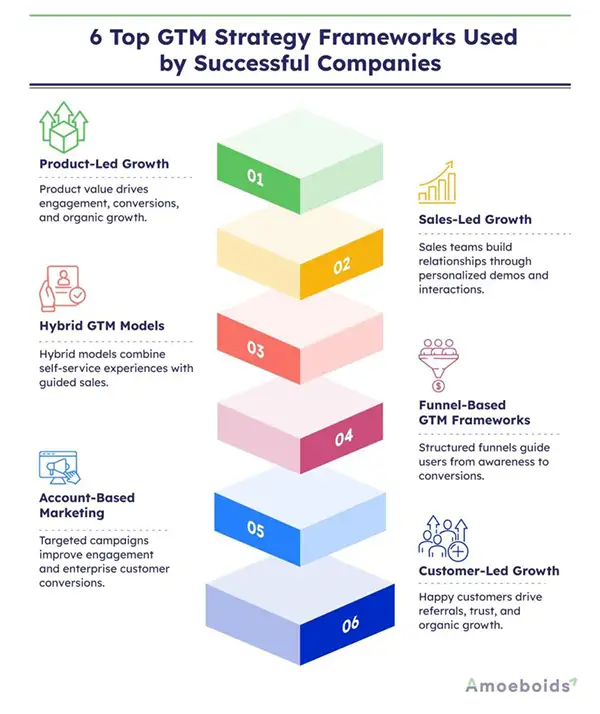
Products are not the same and require different approaches, and these proven GTM strategy frameworks help companies grow, acquire customers, and expand effectively:
Product-Led Growth
The product delivers growth via early value experience, higher usage, enhanced user engagement, more conversions, and organic growth over time.
Sales-Led Growth
Dedicated sales teams engage prospects with personalised demos and relationship building. It is also suitable for complex, high-value products with long decision-making and purchasing cycles.
Hybrid GTM Models
The hybrid of product-led and sales-led creates self-serve experiences and guided sales. Companies get the best of both worlds, flexibility and better acquisition & conversion of customers.
Funnel-Based GTM Frameworks
Taking your users from awareness to consideration to conversion allows them to understand and trust your product. This structured approach keeps messaging, generates engagement, and inspires action.
Account-Based Marketing
Targeting high-value accounts with targeted campaigns helps bridge the gap between marketing and sales. It provides custom experiences that boost engagement, relationships, and conversions in enterprise deals.
Customer-Led Growth
Happy customers become promoters via referrals, reviews & testimonials. This helps to build trust, increase credibility, and drive organic growth by influencing new customers in the marketplace.
How to Choose the Right GTM Framework
The ideal go-to-market strategy framework for you will depend on your product, audience, and growth stage. There’s no single approach, so it’s important to weigh key factors carefully.
- Product type: Your product can be simple or complex, self-serve or high-touch, and this directly relates to what GTM strategy is best (product-led, sales-led, or hybrid).
- Company stage: New startups can rely on product-led methods, while mature companies tend to need more structured frameworks with better sales and marketing alignment.
- Customer buying behavior: Understanding how customers make decisions, whether they prefer self-exploration or guided demos, will help you align your GTM strategy with their expectations.
- Budget & resources: Evaluate your available resources, including team size and budget, to select a GTM framework that is both long-term and adaptable without exceeding your capabilities.
Common GTM Mistakes and How to Avoid Them
You can have the right framework, but execution mistakes can still limit your success. Understanding common GTM mistakes—and how to avoid them—helps you refine your approach and improve results.
- Poor market research: If you don’t do your research, you will end up targeting the wrong audience, which will reduce the effectiveness and product-market fit.
How to avoid it: Before you launch, do some customer research, validate your norms, and use real data.
- Weak positioning: If you don’t clearly communicate the value of your product, your customers may feel confused, which affects acquisition and retention.
How to avoid it: Define a strong value proposition and ensure consistent messaging across all channels.
- Team misalignment: When sales, marketing, and product teams aren’t aligned, it creates unreliable messaging and missed opportunities.
How to avoid it: Establish clear communication, shared goals, and regular cross-team collaboration.
- Ignoring feedback and data: If you don’t use user feedback and performance data, you limit your ability to improve and you slow down growth.
How to avoid it: Continuously monitor metrics, solicit feedback, and iterate your strategy based on findings.
Conclusion
A GTM strategy is not just about launching a product, it’s about unveiling with intent and purpose. When you focus on the right go-to-market strategy framework, align your messaging, and understand your audience, you create a path for actual growth.
It also helps you avoid common mistakes and make better decisions based on insights. The key is to remain flexible, learn from data, and constantly improve your approach.
So, are you ready to build a GTM strategy that actually delivers positive outcomes?
Start using these GTM frameworks today and confidently launch your product into the market.