- A Calendar That Designs The Office Experience Rather Than Just Recording It With Lark Calendar
- Meeting Experiences That Work Equally Well In The Room And On Screen With Lark Meetings
- Documentation That Connects Office Work To Digital Work With Lark Docs
- Operational Continuity Between Office Days And Remote Days With Lark Base
- Communication That Does Not Assume Physical Presence With Lark Messenger
- Bonus: Why Hybrid Work Fails Without Intentional Infrastructure
- Conclusion
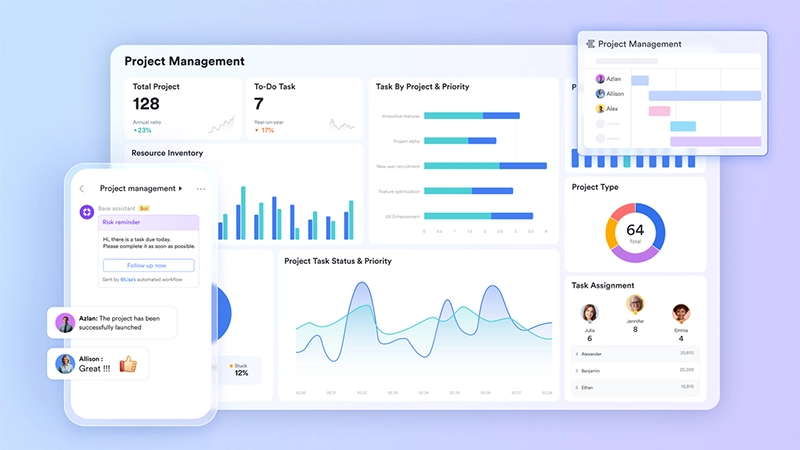
The physical office is not going away. It is being redefined. The organizations that have navigated the return-to-office question most successfully are not the ones that insisted on a return to the pre-pandemic status quo or the ones that went fully remote and never looked back. They are the ones that redesigned their relationship with physical space to serve the types of work that genuinely benefit from physical proximity, collaboration sessions, complex problem-solving, relationship building, and onboarding, while building a digital infrastructure that handles everything else with equivalent or superior quality. In this new model, the office is not where work happens. It is where a specific category of work happens, and the digital tools are not where remote work happens. They are where work happens everywhere, including in the office. The organizations that have successfully built this model have done it with project management tools that make the digital working environment as productive in the office as outside it, rather than treating digital tools as a concession to remote work that office workers can ignore when they are at their desks.
A Calendar That Designs The Office Experience Rather Than Just Recording It With Lark Calendar
In the new definition of office, the calendar is not a passive record of when meetings are happening. It is the primary tool through which the organization designs the working week, ensuring that the days when team members are in the office are the days when the types of work that benefit from physical presence are scheduled, and that the days when team members work remotely are protected for the focused individual work that remote environments often support better.
“Calendar Subscription” to shared team and project calendars gives every team member visibility into when their colleagues are planning to be in the office, so they can align their office days with the people and the collaborative sessions that justify the commute. “Meeting Groups” linked to in-person sessions ensure that every participant arrives with the same preparation regardless of whether they are joining physically or remotely, so the hybrid meeting does not create a two-tier experience where in-office participants have richer context than remote ones. “Schedule in Chat” allows the coordination of in-office collaborative sessions to happen with the same efficiency as the coordination of virtual ones, removing the scheduling friction that causes in-person collaboration to be planned less deliberately than virtual collaboration.
Meeting Experiences That Work Equally Well In The Room And On Screen With Lark Meetings
The hybrid meeting is the hardest coordination challenge in the new definition of office, because the in-person meeting dynamics that work when everyone is in the room do not work when half the participants are on a screen. The remote participant who cannot hear the side conversation, cannot see the whiteboard, and cannot participate in the breakout group that happened informally while the meeting was wrapping up has a fundamentally different meeting experience from the in-person participant, and the quality gap has real consequences for their ability to contribute and their sense of inclusion.
“Magic Share” eliminates the whiteboard asymmetry by allowing every participant, whether in the room or remote, to interact with a live shared document simultaneously. “Group Meetings” with breakout sessions allow the in-person session to divide into mixed in-person and remote groups where every participant has a genuine small-group conversation rather than observing the room’s dynamic from a video feed. Real-time meeting participation features give every participant an equivalent interaction channel regardless of their physical location relative to the meeting room.
Documentation That Connects Office Work To Digital Work With Lark Docs
The conversation that happened in the office on Tuesday needs to produce a record that every remote team member can access on Wednesday with the same quality as the in-person participants’ memory of the conversation. The whiteboard photograph sent to a Slack channel is not that record. The meeting summary typed into a shared document by a single participant is a better approximation but still depends on one person’s recall and interpretation. The live document that every participant contributed to during the in-person session is the record that actually serves the remote team member.
Real-time co-editing allows in-person participants to build the shared documentation of their session simultaneously rather than relying on one person to produce a subsequent summary, so the document record reflects the collective thinking of the in-person session rather than one participant’s recollection of it. “@mention” within the document allows in-person participants to assign actions to remote team members at the point in the document where those actions arise, connecting the in-person session’s outputs to the remote team member’s workstream in real time rather than through a subsequent communication step. “Version History” makes the document’s evolution transparent to every team member who joins the project after the in-person session, so the reasoning behind the in-person decisions is available to everyone rather than only to those who were in the room.
Operational Continuity Between Office Days And Remote Days With Lark Base
The new definition of office requires an operational system that functions identically whether the team member is working from the office, from home, or from anywhere else. The project tracker that requires a VPN connection to access, the dashboard that only displays correctly on a desktop, and the database that is maintained by the team member who is in the office on Tuesdays and Thursdays create the operational inconsistency that makes hybrid work feel less coherent than either fully office-based or fully remote work.
Lark Base is accessible from any device and any location with the same full functionality, so the team member who shifts between office and remote work during the week has a consistent operational experience regardless of where they are. Personal task views give every team member the same self-directed workflow management whether they are at their office desk or their kitchen table. Automated notifications keep every team member synchronized with the project’s progress regardless of whether they are in the office on the day a significant status change occurs.
Communication That Does Not Assume Physical Presence With Lark Messenger
The new office model fails when its communication culture assumes physical presence for some team members and treats remote participation as a concession. The hallway conversation that produces a decision that is never communicated to the remote team members who are affected by it is the most common failure mode of hybrid work, and it persists not because of bad intentions but because the communication infrastructure does not create a natural incentive to document and share in-person interactions.
Group folder organization with project-specific communication groups creates the structural incentive to communicate formally rather than informally, because the formal channel is where the project’s communication record lives and where remote team members have access. “Scheduled Messages” allow the hybrid team to maintain a consistent communication cadence regardless of which team members are in the office on any given day, so the communication rhythm does not depend on physical proximity to maintain. “Read/Unread Status” gives the sender of hybrid communications confirmation that every remote team member, not just the ones in the office, has received the information they need to stay aligned.
Bonus: Why Hybrid Work Fails Without Intentional Infrastructure
Hybrid work fails when it is implemented as a scheduling policy rather than as an operational design. The organization that tells its team members they can work from home two days a week without redesigning its communication norms, its meeting formats, its documentation practices, and its project visibility infrastructure has created a permission without an enabler. The remote days are less productive than the office days because the infrastructure was not designed to support them equally.
Tools like Zoom and Microsoft Teams make hybrid meetings possible but do not make them equal. Notion and Confluence make documentation possible but do not make it a natural byproduct of in-person work. Teams evaluating Google Workspace pricing for hybrid work often find that core collaboration tools are only part of the setup. Many add separate tools to support scheduling, communication, documentation, and coordination across in-office and remote employees, which can create inconsistent experiences across locations. Lark provides the same operational environment regardless of where employees work, helping hybrid teams stay aligned without managing separate workflows for in-person and remote work.
Conclusion
The new definition of office is not a compromise between full-time office work and full-time remote work. It is a deliberate design that uses physical space for work that genuinely benefits from it and digital infrastructure for everything else. A connected set of productivity tools that provides an equivalent operational experience in the office and outside it, designs the working week deliberately through calendar intelligence, makes meetings genuinely inclusive of every participant’s location, connects in-person work to the digital record that remote team members depend on, and maintains communication norms that do not privilege physical presence over remote participation is how organizations make the new definition of office work in practice rather than just in principle.