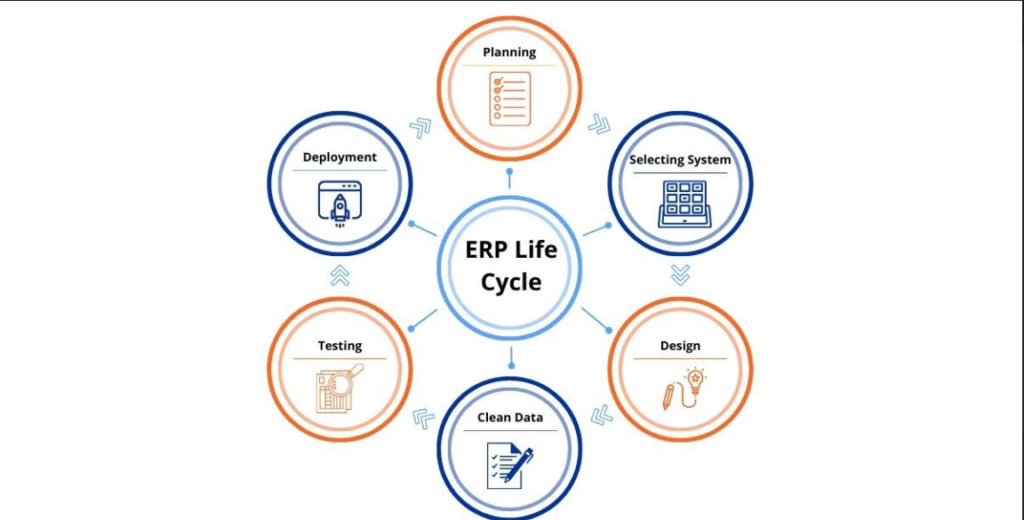
ALT: ERP implementation life cycle
Cloud ERP solutions need high coordination between teams and stages. Application Lifecycle Management assists in addressing this challenge from development through to the steady state. Application lifecycle management integrates planning, testing, and training into one process. Without this, change implies risk and inefficiency. A sound execution framework keeps business goals and system measures in sync.
- Strategic Planning for Cloud ERP Initiatives
A lifecycle strategy has to be developed before the development process. Cloud ERP is not a project. It is a program. Organizations need to establish ownership and success factors. Business and technical people need to collaborate on a common roadmap. When strategy is aligned and synchronized, organizations can avoid confusion and enable sustainable growth.
- Governance and Change Controls
Cloud systems are updated regularly. Each update may affect finance, HR, or supply chain operations. Good governance helps analyze, test, and approve each update. Analysis and traceability minimize risks. Governance helps define control policies to ensure compliance and audit readiness. With good governance, enterprises can enable innovation without compromising system stability.
- Design and Configuration Alignment
Most of the failures in the ERP system occur when there is a mismatch between design and configuration. The lifecycle approach ensures that the design documents remain in sync with the actual system configuration. There are better visibility and fewer defects in production. It also ensures that the business requirements are properly captured in the system behavior.
- Release Readiness
Testing needs to be done over the whole lifecycle. Quarterly Cloud releases need regression validation to avoid disruption. Manual validation causes delays and is expensive. A lifecycle-focused approach integrates automation into the release process. Self-updating test assets and impact recognition enhance speed and certainty. Continuous validation ensures that go-lives and updates occur seamlessly.
- Training and Operational Resilience
Adoption by users defines ERP success. Training needs to be based on actual system configuration and tested processes. As long as the training material remains relevant to updates, employees will adopt faster. Lifecycle management helps to minimize support requests and operational ambiguity.
- Unified Lifecycle Execution with Intelligent Automation
Businesses require an integrated platform to link the define, design, configure, test, and train steps. The CALM platform by Opkey offers this with an orchestration layer and more than twenty AI agents. The Argus AI engine in the platform recognizes Cloud applications in an enterprise and links process intelligence with configuration tracking. Organizations have thousands of test assets ready for use with the platform, and this helps them avoid tool fragmentation and achieve faster deployments with managed updates.
- Risk Management and Compliance Assurance
Risk management is an essential aspect of Enterprise Application Lifecycle Management for Cloud ERP. Every change in the configuration, integration, or quarterly release has operational and regulatory implications. An organized lifecycle framework involves risk categorization, compliance correlation, and approval process documentation. This helps ensure that financial management and audit processes are not compromised.
The Last Line
In conclusion, enterprise Application Lifecycle Management for Cloud ERP needs planning, control, and disciplined execution. A unified lifecycle management approach is less risky and enhances system value. With the integration of orchestration intelligence and AI QA automation, organizations can optimize their applications, minimize IT expenses, and have complete lifecycle control. Opkey makes this process easier with an AI-native platform that acts as an agent with a focus on enterprise Cloud systems.